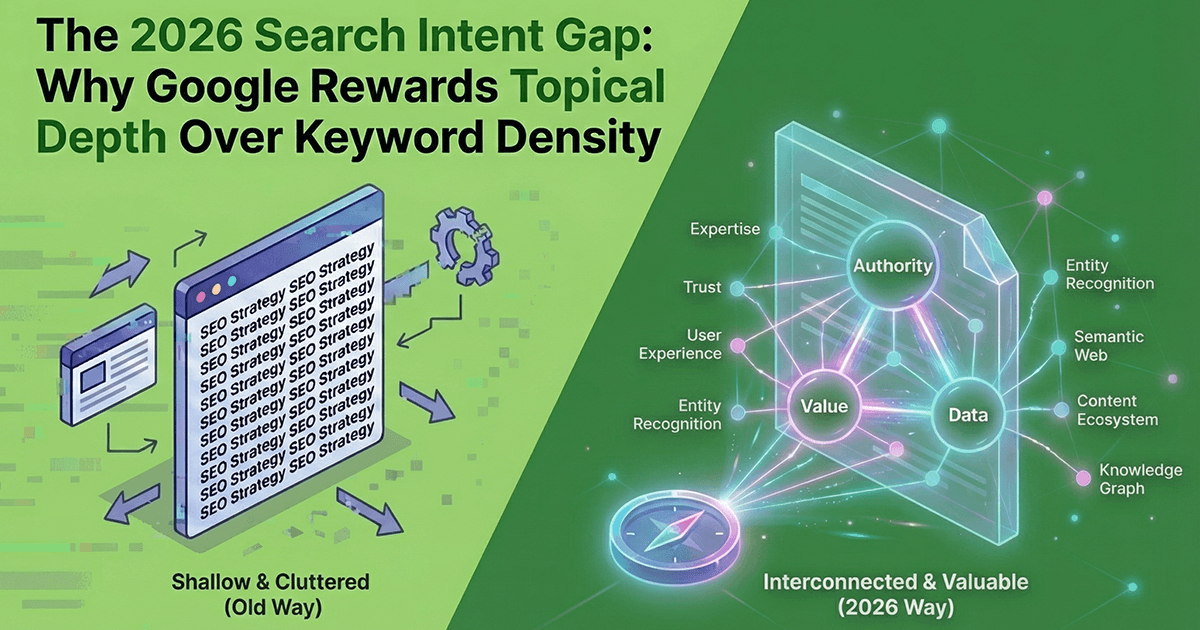
If you have ever thought, “My keywords are in the right places, but I am still stuck on page 2,” you are not alone. This frustration is often the result of a lack of Information Gain. You can rank for a specific phrase and still fail to provide unique value to the user. This disconnect between matching words and providing actual insight is what we call the search intent gap.
In 2026, Google is no longer focused on counting words or matching strings, which is called Lexical Retrieval. It evaluates whether your content actually satisfies user search intent by mapping meaning, a process known as Semantic Synthesis. Understanding the search intent gap explains why traditional keyword-first content stalls, and why topical depth vs. keyword density has become the defining SEO shift of this decade.
Exposing the Search Intent Gap

The search intent gap appears when content technically targets a keyword but fails to meet the expectations behind the query. This is where many SEO strategies quietly break down. A Rankability study found that pages ranking in the top 10 positions often had nearly 50 percent lower keyword density than pages stuck on page 3. This contradicts the long-held belief that repeating a phrase increases relevance. In reality, excessive repetition now signals noise rather than clarity.
Google’s MUVERA-based systems classify repetition as a failure to resolve the intent gap. MUVERA interprets keyword fixation as a sign that the content lacks the semantic richness required to answer complex queries. Pages that bridge the search intent gap do so by answering follow-up questions, covering related topics, and demonstrating knowledge depth instead of fixation on a single phrase.
Closing the Search Intent Gap with Topical Depth

Closing the search intent gap requires a shift toward topical depth, not higher keyword density in 2026. Top-ranking pages consistently demonstrate broader topical authority by addressing the full scope of user search intent. Backlinko research indicates that the top three results typically reference a wider range of connected entities than results ranked four through ten.
The pages that perform best often use fewer keywords but answer more implied questions. This is search intent alignment in action. It reflects an understanding of informational vs. commercial intent, and how users move through the search journey mapping process. This is where topical authority becomes measurable through the Entity Proximity Model. By reducing the semantic distance between your content and core industry concepts, you provide information users did not realize they needed. Pages that close the search intent gap in this way prove their expertise by satisfying the Google Knowledge Graph API requirements for depth and relevance.
Find Where Your Content Falls Short of Search Intent
Run a SinglePage SEO Content Analysis to see how well your page aligns with real user search intent. The report surfaces where content gap analysis, header structure, and topical coverage falls short, then translates those findings into a clear SEO optimization plan.
Begin Your Content Audit Now!Case Study: Bridging the Search Intent Gap in Cloud Security

The Problem
A long-form article targeting “Cloud Security Best Practices” followed every traditional SEO rule. It maintained a 2.5 percent keyword density, optimized H2s, and earned strong backlinks. Despite this, it remained at Position 14. The content ranked for the term but failed to close the search intent gap.
The Diagnosis
The page was lexically optimized but semantically thin. It lacked essential entities such as “Zero Trust Architecture” and “Inertia Attacks.” These omissions signaled weak entity SEO coverage and insufficient content depth based on how Google measures content depth.
The Intervention
Using the SinglePage SEO Optimization Plan, the focus shifted away from repetition and toward closing 18 identified topical gaps. The header structure was refined, paragraphs were expanded with relevant entities, and semantic SEO strategy principles were applied.
The Result
Keyword density dropped to 0.7 percent. The information gain in SEO score tripled. Within 22 days, the page reached Position 2. The search intent gap was resolved by answering the user’s next question, not by adding more keywords.
Why Manual Intent Mapping No Longer Works

Manual content gap analysis across multiple competitors requires auditing titles, metadata, headers, internal links, and user satisfaction signals. This process often takes eight or more hours and still leaves room for error.
Bridging the search intent gap involves variables like engagement data, entity coverage, and topic clusters for 2026. Without automation, SEO professionals rely on assumptions rather than evidence. This leads to inconsistent user search intent optimization and missed opportunities.
Constructing Relevance with SinglePage SEO

SinglePage SEO provides a structured way to resolve the search intent gap using data, not guesswork. The Content Analysis Report provides a granular audit of the metrics that actually influence semantic relevance and drive Information Gain:
- SEO Metrics: This section provides the scores out of 100 for Title Tags, Meta Description, Header Structure, and Content Length. It also evaluates User Engagement and keyword Optimization to pinpoint exactly where your page lacks technical authority.
- Suggested Keywords: This section identifies unique, high-impact keywords required for topical depth. Every suggestion is labeled as High, Medium, or Low priority. This ensures your content incorporates the unique concepts necessary to achieve high Information Gain.
- Content Improvement: You receive direct recommendations to refine headings, paragraphs, and metadata. These actionable insights help you build in-depth content that closes informational gaps, ensuring your page offers new value rather than duplicating existing results.
- SEO Optimization Plan: The report concludes with strategic recommendations focused on search intent alignment. This includes Content Optimization to enhance keyword placement, On-Page SEO to strengthen internal linking, and UX strategies to resolve hidden gaps that lead to high bounce rates.
This approach replaces guesswork with a measurable entity-based SEO strategy that satisfies modern search expectations and closes the search intent gap with precision.
The 2026 SEO Roadmap

SEO in 2026 prioritizes topical depth over keyword density and meaning over repetition. The search intent gap explains why surface-level optimization no longer works. Understanding this shift is only the first step. Executing it requires a system that evaluates content depth metrics, search intent alignment, and entity coverage at scale. SinglePage SEO provides that system, helping teams move from keyword tracking to measurable authority.
Get a Clear SEO Optimization Plan Based on Search Intent
Closing the search intent gap starts with understanding how your content compares to what already ranks. The SinglePage SEO Content Analysis tool evaluates search intent alignment, highlights missing topical coverage, and delivers a focused SEO optimization plan.
Start Planning Your Content Today!