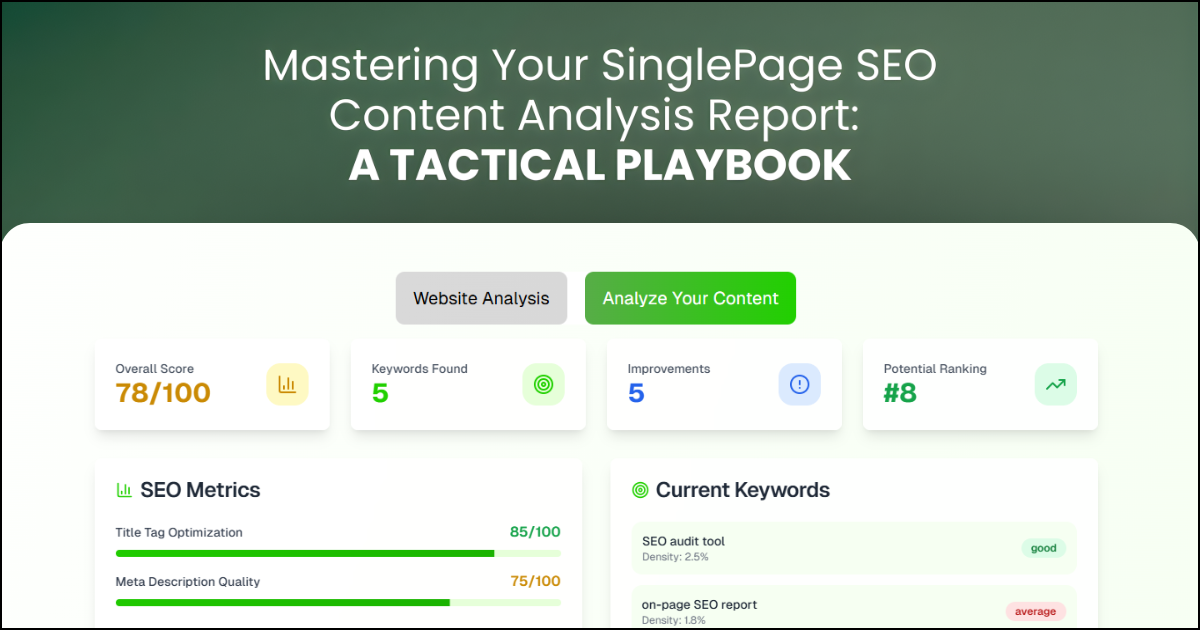
The SinglePage SEO Content Analysis Report is your clear, actionable roadmap to transforming your page content. It focuses on driving higher search visibility and user engagement by removing the guesswork from content optimization. Whether you're optimizing your first piece of copy or managing a large content portfolio, this guide provides the detailed walk-through you need, transforming raw analysis into a prioritized, tactical plan for maximum search performance.
Purpose and Value Proposition
This guide’s purpose is to demystify the data within your Content Analysis Report, converting it from a mere diagnostic score into a tactical content execution plan. Consider this essential blueprint for maximizing topical authority and user-intent alignment. By focusing on the prescribed, prioritized steps, you will surgically resolve optimization gaps, driving immediate gains in organic rankings and achieving sustained, measurable audience growth.
Important Note on Data: This guide is designed to explain the structure and intent of the Content Audit Report. All scores (e.g., "78/100"), metrics, and specific details mentioned in the sections below are provided as illustrative examples for guidance only. They do not represent data from any actual content audit or live report.
Section 1: Overall Performance Summary (The At-a-Glance Snapshot)

This section provides the high-level health metrics of your audited page, allowing for immediate prioritization.
1. Overall Score (Example: 78/100):
This is a weighted composite score reflecting your page's combined Content Quality, Technical Health, and Optimization completeness.
- Tip: Always aim for a 90+ score; every point below 100 indicates an opportunity.
2. Keywords Found (Example: 5):
The total number of relevant, unique keywords the tool identified within the page's current content. This gives you context on the density and variety of your current keyword usage.
- Tip: A higher count suggests better existing topical coverage; a low count signals the need for keyword-driven content expansion.
3. Improvements (Example: 5):
Your immediate action count. This number directly represents the number of high-priority tasks in the "Instant Content Improvements" and "Optimization Plan" sections that demand your attention.
- Tip: Treat this number as your initial, prioritized to-do list; completing these tasks is the fastest way to increase your Overall Score.
Potential Ranking (Example: #8):
An estimated, attainable ranking position if all identified improvements are implemented. This provides a clear business case for focusing on the recommendations in this report.
- Tip: Use this metric to gauge the immediate potential return on investment (ROI) of completing the optimization plan.
Section 2: Core SEO Metrics Breakdown (Scoring Deep Dive)

This section provides the granular detail behind your Overall Score. It is composed of six individual metrics, each independently graded out of 100, that determine your page's technical and content health. A score of 100 is the goal, indicating maximum optimization and performance potential; lower scores pinpoint specific critical errors or optimization gaps.
1. Title Tag Optimization (Example: 85/100):
This score reflects the report's assessment of your title tag's optimal length, inclusion of the primary keyword, and alignment with user search intent.
- See Section 5 for Reference: Instant Content Improvements for immediate fixes.
2. Meta Description Quality (Example: 75/100):
This metric measures the presence of a clear call-to-action (CTA) and descriptive content, indicating its potential to maximize click-through rate (CTR) from the search results.
- See Section 5 for Reference: Instant Content Improvements and Section 6: On-Page SEO Focus for optimization tasks.
3. Content Quality & Length (Example: 80/100):
This score compares your content's word count and topical breadth against the ranking competitor average identified by the tool. A low score indicates insufficient depth or topic coverage.
- See Section 6 for Reference: Content Optimization Focus and Content Strategy Focus for expansion strategy.
4. Keyword Optimization (Example: 70/100):
This score assesses the natural distribution and variety of your primary and secondary keywords, penalizing for keyword stuffing while rewarding strategic placement throughout the content.
- See Section 6 for Reference: Content Optimization Focus for improvement steps.
5. Header Structure (Example: 85/100):
This score confirms the technical health and flow of your content hierarchy, specifically checking for a single H1 and the logical nesting of H2s and H3s for structure and accessibility.
- See Section 5 for Reference: Instant Content Improvements and Section 6: User Experience Focus for immediate fixes and enhancement tasks.
6. User Engagement Signals (Example: 65/100):
This metric uses on-page indicators, like average paragraph length, image inclusion, and use of bulleted lists, to predict how users and search engines will perceive your page’s readability and structure.
- See Section 6 for Reference: User Experience Focus and On-Page SEO Focus for enhancement tasks.
Section 3: Current Keyword Analysis (The Baseline)

This section analyzes all keywords the tool detected in your page's existing content, providing a critical baseline of your current topical focus, usage density (as a percentage), and keyword quality labels (Good/Average/Poor) before any optimization begins. These metrics help identify both immediate risks, such as Keyword Stuffing, and missed opportunities for relevance.
1. Interpreting Density:
The report shows the current frequency of each keyword as a percentage. This data helps you determine if the keyword usage falls within the ideal range. If the density percentage is flagged as too high, the report suggests you are at risk of Keyword Stuffing, which can negatively impact rankings. If it is too low, the report suggests a missed opportunity for topical relevance.
2. Understanding Quality Labels:
Each identified keyword is assigned a Good/Average/Poor quality label. This label reflects the tool's assessment of the keyword's contextual relevance and its placement within key on-page elements (like titles, headings, and the body copy).
- Good: The keyword is used effectively and appropriately.
- Average/Poor: The keyword is either underutilized or used in a way that doesn't strongly communicate topical relevance to search engines. Addressing Poor quality keywords is a high priority for improving your content's score.
Section 4: Suggested Keywords (The Growth Opportunity)

This section is the strategic heart of the report, providing a list of high-value, relevant keywords your page is not currently targeting, along with key metrics to help you prioritize their integration for maximum impact.
1. Priority (High/Medium):
This label indicates the urgency and relevance of the suggested keyword to your current topic.
- Tip: Keywords marked High should be integrated immediately to capture immediate traffic potential.
2. Estimated Value ($/month):
This metric gives you a sense of the monthly traffic and conversion value you could capture if you successfully rank for this keyword.
- Tip: Use this metric to gauge the potential return on investment (ROI) of incorporating the keyword.
3. Difficulty (Low/Medium/High):
This score reflects the competitive landscape for the keyword.
- Tip: Target Low and Medium difficulty keywords first for quick wins and efficient score improvement before tackling highly competitive terms.
4. Goal/Rationale:
This brief explanation links the suggested keyword to your broader content strategy (e.g., "Targeted traffic increase," "Broaden content scope," or "High conversion potential").
- Tip: Before integrating, identify your primary goal for the page (e.g., traffic or conversion) and prioritize keywords that align with that target.
Section 5: Instant Content Improvements (Copy-Paste Wins)
This section provides the fastest path to increasing your score through immediate, copy-paste changes by offering pre-written optimization suggestions generated by the tool. While accepting these suggestions is generally beneficial for your overall score, you should review them for brand voice and context before implementation. The goal is to maximize efficiency and minimize the time spent rewriting content.
1. High-Priority Edits (Title and Meta Description):

The report provides optimized Title Tag and Meta Description copy.
- Purpose: These edits directly and immediately impact search result visibility (Title Tag) and click-through rate (Meta Description), offering the highest return for minimal effort.
- Benefit: Implementing these changes gives you the quickest possible boost to your page's visibility and search performance, maximizing your click potential right away.
2. Medium/Low-Priority Edits (Headings and Paragraphs):

This category includes suggestions for improving your content's internal structure and flow, such as optimized H2 and H3 headings and revised introductory or key body paragraphs.
- Purpose: These suggestions aim to enhance user engagement and readability while also boosting the page's latent semantic indexing (LSI) score by strategically incorporating important secondary keywords.
- Benefit: These improvements lead to better user retention, lower bounce rates, and a clearer topical signal to search engines, solidifying your page's relevance over time.
3. The Rationale (Why the Change Works):

For every suggested "After" copy, the report provides a brief explanation of why the change is better than the original "Before" copy.
- Purpose: This explanation ensures you understand the strategic value of the change, typically focusing on improved keyword context, stronger call-to-action (CTA), or benefit-driven language.
- Benefit: Understanding the rationale allows you to apply the same strategic thinking to future content creation, reducing your reliance on the tool for basic optimization tasks.
Section 6: SEO Optimization Plan (Strategic Tasks)
This is the long-term execution manual, providing a strategic plan broken down by area, impact, and time estimate.
Understanding the Task Card

Each strategic task in the Optimization Plan is presented on a Task Card that clearly defines four variables to guide your execution:
1. Priority (High, Medium, or Low):
This metric indicates the urgency of the task.
- Tip: HIGH Priority tasks should be tackled before Medium/Low tasks, as they will have the most immediate positive effect on your score.
2. Time Estimate (e.g., 10 mins, 1 hour, 4 hours):
This is the projected time needed to complete the action steps.
- Tip: Use this metric for time-blocking and batching similar tasks together for maximum efficiency.
3. Impact (e.g., High, Medium, Low):
This is the projected score increase or performance boost from completing the task.
- Tip: Prioritize High Impact tasks within the same Priority level (e.g., complete High Priority, High Impact tasks first).
4. Action Steps:
These are the definitive, measurable steps to complete the task.
- Tip: Follow this sequence exactly to ensure the optimization is correctly applied and the tool registers the improvement upon re-audit.
Content Optimization Focus

This section targets improvements directly related to the quantity, quality, and keyword usage within the main body of your content.
1. Improving Keyword Density:
Tasks focused on achieving the optimal frequency of targeted keywords.
- Action Steps: Identifying under-used words and natural reintegration of keywords.
- Tip: Ensure the revised copy maintains readability and does not engage in keyword stuffing.
2. Updating Old Content:
Tasks addressing content that is outdated or no longer competitive.
- Action Steps: Review existing content for outdated information and update content and keywords.
- Tip: Always check the Content Quality & Length score in Section 2 to determine if a full content refresh is needed to meet competitor averages.
On-Page SEO Focus

This section addresses the non-content, technical elements that appear on the page itself, essential for maximizing click-through rates and image indexing.
1. Optimizing Meta Descriptions:
Tasks dedicated to improving the snippet shown in search results.
- Action Steps: Identify pages with low CTR and Rewrite meta descriptions with engaging language.
- Tip: Focus on using strong, benefit-driven language and including the primary keyword to increase the likelihood of a click.
2. Optimizing Image Alt Tags:
Tasks for ensuring all images have descriptive, keyword-rich alternative text.
- Action Steps: Check current alt tags and Rewrite alt tags with relevant keywords.
- Tip: Describe the image accurately for accessibility, while naturally incorporating relevant keywords for image search visibility.
Content Strategy Focus

This section focuses on long-term content planning tasks that ensure your page contributes to a wider, authoritative topic cluster.
1. Expanding Content on Target Topics:
Tasks related to creating new content based on suggested keywords.
- Action Steps: Research additional topics related to target keywords and create new content pieces addressing these topics.
- Tip: Use the Suggested Keywords section (Section 4) as your primary source for new topics to ensure your content expansion aligns with high-value search demand.
User Experience Focus

This section lists tasks designed to improve how human readers and search engines navigate and consume your content.
1. Enhancing Readability with Subheadings:
Tasks centered on using structural tags (H2s and H3s) effectively.
- Action Steps: Add subheadings to sections with dense text and Ensure subheadings are keyword rich.
- Tip: Prioritize implementing H2s and H3s where the content is highly dense to improve both the user's scanning experience and the search engine's ability to understand the content hierarchy.
Conclusion: Your Next Steps
Stop analyzing and start ranking. Execution is mandatory to capture the projected traffic and ranking potential identified in this report.
The Execution Loop: Implementation Strategy
The most efficient way to use the report is to tackle the Instant Content Improvements (Section 5) first, as they offer the quickest score boost. Once those are complete, systematically work through the Optimization Plan (Section 6), prioritizing tasks marked HIGH Priority. This sequence ensures the maximum return on your time investment.
Re-Audit: Measuring Success
It is crucial to run the tool again immediately after implementation. A re-audit will provide a new Overall Score, track the improvement registered from your actions, and often identify the next set of lower-priority tasks that have now become the "low-hanging fruit" for optimization. This feedback loop is essential for continuous performance growth.
Ready to Accelerate Your Strategy? Contact SinglePage SEO Today.
If you need specialized expertise for complex technical issues, content management, or rapid growth, contact SinglePage SEO now. We provide advanced strategy, hands-on training, and deeper technical analysis to accelerate your ranking goals.