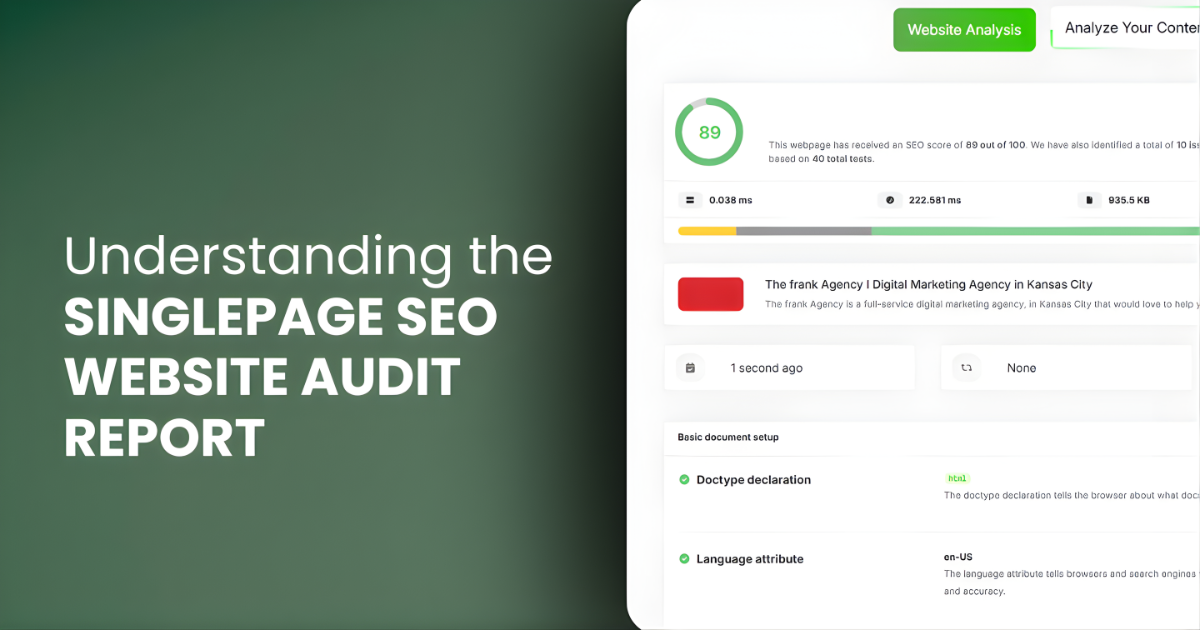
The SinglePage SEO Website Audit Report is your clear, actionable roadmap to improving website health, search visibility, and user experience. It removes the guesswork from optimization. Whether you’re just starting your SEO journey or are an experienced developer, this guide will walk you through every section of your report, turning complex data into a prioritized action plan.
Purpose and Value Proposition
The goal of this guide is to cut through the complexity of the raw audit data and give you a clear, prioritized action plan. This is your essential tool for solidifying your technical SEO foundation. By following these straightforward steps, you will quickly address critical issues, leading directly to higher search visibility and tangible improvements in conversion rates.
The SEO Scorecard (Health Snapshot)
This section gives you an immediate, high-level overview of your page's performance and status, acting as a quick reference for overall health.

1. The SEO Score
- Definition: A comprehensive grade (e.g., 91/100) representing your current website health based on a weighted average of all passed and failed technical checks.
- Actionable Insight: The primary purpose of using this report is to address the identified issues and push your overall score higher. This score is a benchmark for your optimization progress.
2. Website Domain Audited
- Definition: The exact, canonical URL and domain name for which the entire report was generated.
- Actionable Insight: This simply identifies the exact URL for which the report was generated. Its importance is confirming that the focus of the audit is correct, ensuring you are working on the right page.
3. Overall Test Summary (The Snapshot)
- Definition: A quantitative breakdown of the audit's findings, summarizing the number of successful tests versus the total number of issues found.
-
Actionable Insight:
This provides full summary context for your score.
- Issues: These are your immediate priority, what you need to fix now. Each issue directly pulls down your score and needs to be addressed.
- Passed Tests: These represent what you are doing correctly. Keep doing these things, as they are the foundation you need to maintain.
(Core Web Vitals Foundation)
This section is vital, as these primary performance measurements directly affect user experience and Google's ranking signals. Optimizing these is key to achieving excellent Core Web Vitals.

1. TTFB (Time to First Byte)
- Definition: Measures the time from an HTTP request being sent to the first byte received by the browser. It primarily measures server responsiveness, not full page load.
- Actionable Insight: A low TTFB is crucial, signaling a fast, responsive server. A high TTFB often points to slow server-side processing or inadequate hosting, it’s typically a hosting or backend code issue.
2. Response Time
- Definition: The total time taken to complete the entire request, from the connection stage to receiving the full server response.
- Actionable Insight: This represents the overall speed of communication. Faster times improve user retention and contribute positively to Core Web Vitals.
3. Page Size
- Definition: The total size of the page's source code downloaded (excluding external assets like images and scripts).
- Actionable Insight: Keep your page size below 150 kB. Smaller code size means faster initial loading and parsing by the browser.
4. HTTP Requests
- Definition: The total number of ‘separate calls’ your browser makes to the server to fetch resources (Images, Scripts, Stylesheets).
- Actionable Insight: Fewer requests minimize network congestion and back-and-forth communication, directly accelerating load time. The goal is to consolidate resources.
Brand Identity and Search Snippet Optimization
These elements are your first impression on both users and search engines in the results pages.

1. Primary Social Image (Open Graph Image)
- Definition: This is the image specified by the og:image meta tag. It is the visual asset that appears when your page is shared on social media platforms like Facebook, X, and LinkedIn.
- Actionable Insight: The Open Graph Image is your most visible social element. It must be compelling, high-resolution (e.g., 1200x630 pixels), and correctly configured to maximize click-through rates from social shares.
2. Meta Title
- Definition: The most critical text element displayed as the clickable headline in search engine results pages (SERPs).
- Actionable Insight: This is your most critical on-page signal. Ensure it includes your primary keywords, includes your brand name, and stays within 50-60 characters to avoid truncation in search results.
3. Meta Description
- Definition: The short paragraph of text displayed below the Meta Title in SERPs, serving as a pitch to the user.
- Actionable Insight: This confirms the pitch for your page and is vital for improving your click-through rate (CTR). Keep it compelling and under 150-160 characters.
Basic Document Setup
This section checks the technical foundation of your webpage, ensuring browsers and accessibility tools can correctly interpret the page.
Doctype Declaration

- Definition: The required preamble at the very beginning of an HTML document that specifies which HTML standard is being used (should be <!DOCTYPE html>).
- Actionable Insight: The <!DOCTYPE html> tag must be present and correctly formatted at the very top of the HTML file for modern rendering standards.
Language Attribute

- Definition: The lang attribute on the <html> tag that defines the primary language of the document (e.g., lang="en").
- Actionable Insight: The lang attribute (e.g., lang="en-US") is essential for accessibility (screen readers) and international SEO to specify the page’s primary language.
Meta Charset

- Definition: A metadata tag that defines the character encoding for the document, typically set to UTF-8.
- Actionable Insight: The <meta charset="UTF-8"> tag ensures all characters (especially special or non-English ones) display correctly, preventing garbled text.
Meta Viewport

- Definition: A metadata tag that gives the browser instructions on how to control the page's dimensions and scaling on mobile devices.
- Actionable Insight: This tag (<meta name="viewport"...>) is crucial for mobile responsiveness. If it’s missing or incorrect, search engines will penalize your site's mobile usability score.
Favicon Check

- Definition: The audit's verification that the favicon file is correctly linked and loadable.
- Actionable Insight: Confirms the presence of the <link rel="icon"...> tag, which displays the icon in browser tabs and aids branding and user recognition.
On-Page SEO: Content Signals and Indexing Control
This section addresses how search engines crawl, index, and evaluate the relevancy of your page content.
Core Content Elements
This audit ensures your most visible elements are optimized for users and search engines.
Title Tag (Review):

- Definition: Same as Meta Title, verified here against best practices for keyword inclusion and length.
- Actionable Insight: Ensure it is unique, includes your primary target keywords, and stays within 50-60 characters to maximize CTR.
Meta Description (Review):

- Definition: Same as Meta Description, verified here for compelling content and length adherence.
- Actionable Insight: Write compelling, persuasive copy that encourages the user to click. Include a call-to-action (CTA) and stay within 150-160 characters.
H1 Tag:

- Definition: The most important heading tag, used by search engines to understand the primary topic of the page.
- Actionable Insight: Use only one H1 tag per page. It must be the most prominent heading and accurately reflects the page's content and target keyword.
Crawling and Indexing Control
These elements tell search engines how to handle your page.
Meta Robots Tag:

- Definition: An HTML tag placed in the <head> section that instructs search engines how to crawl or index the page (e.g., index, follow, noindex, nofollow).
- Actionable Insight: Check that the <meta name="robots"...> tag does not contain noindex if you want the page to appear in search results.
Header Robots Tag (X-Robots-Tag):

- Definition: An HTTP response header that serves the same function as the Meta Robots tag, often set by the web server configuration.
- Actionable Insight: This instruction is sent in the HTTP response headers. It is often overlooked but has the same effect as the Meta Robots tag. Check server configurations (Apache/Nginx) for accidental noindex instructions.
Canonical URL:

- Definition: A tag (<link rel="canonical" href="...">) that tells search engines which URL is the preferred version of a page among a set of duplicates.
- Actionable Insight: This is crucial for preventing duplicate content issues. The URL should point to itself or the preferred version if duplicates exist.
SEO Friendly URL:

- Definition: An assessment of the URL structure, checking for use of lower case letters, hyphens, and conciseness.
- Actionable Insight: Use lowercase, hyphens (-), and keep it concise to improve readability for both users and search engines.
Structure and Social Snippets
Open Graph (OG) Tag Completeness:

- Definition: Protocol tags (e.g., og:title, og:description, og:url) used alongside the primary image to control content previews when shared on social media.
- Actionable Insight: Ensure all necessary Open Graph tags are fully and accurately filled out. Complete OG data (including title and description) is vital for ensuring attractive social snippets and higher referral traffic.
Other Headings (H2-H6):

- Definition: Secondary heading tags used to structure and segment the page's content into digestible topics and subtopics.
- Actionable Insight: The audit counts all heading tags. Structure is key. Ensure you have a logical, hierarchical structure to improve readability and search engine understanding of your main topics and subtopics.
Meta Keywords:

- Definition: A legacy metadata tag used historically to list keywords relevant to the page content.
- Actionable Insight: This tag is deprecated by search engines. While mostly harmless, confirming their presence or removal is important for overall code hygiene and reducing redundant markup.
Content Depth and Code Efficiency
This section evaluates the quality of your content and the underlying code supporting it.
Content Density
Words Count:

- Definition: The total number of visible words on the page's main content area, excluding navigation and footers.
- Actionable Insight: The Actionable Goal is to aim for at least 300 words. Comprehensive content that fully answers a user's query often ranks better.
Top Used Words/Keywords:

- Definition: An analysis identifying the most frequently occurring words to assess topic relevance and keyword usage.
- Actionable Insight: This analysis confirms that your primary target keywords are naturally and adequately represented in your content, demonstrating topic relevance without keyword stuffing.
Code Cleanliness and Efficiency
Focusing on code hygiene is essential for fast loading times and maintainability.
Deprecated HTML Tags:

- Definition: HTML elements or attributes that are no longer supported or recommended by modern web standards (e.g., <center>, <font>).
- Actionable Insight: Remove these to improve maintainability and ensure future compatibility with browsers and search engines.
Inline CSS:

- Definition: Styling rules applied directly to individual HTML elements using the style attribute, rather than external or internal stylesheets.
- Actionable Insight: Avoid this. Styles should be moved to external CSS files for faster loading, better caching, and easier maintenance.
Plaintext Emails:

- Definition: Email addresses displayed directly in the HTML without any obfuscation.
- Actionable Insight: Plaintext emails are easily scraped by spam bots. Consider obfuscating the email or using a contact form to reduce spam risk.
Text to HTML Ratio:

- Definition: The ratio of the visible text content size to the overall HTML source code size.
- Actionable Insight: The Actionable Goal is to aim for higher. A low ratio suggests excessive code bloat relative to valuable content.
Image Optimization: Speed and Accessibility
Images are often the largest assets on a page, making optimization crucial for page speed and inclusive design.
Image Formats

- Definition: The file type used for images (e.g., JPEG, PNG, WebP, AVIF).
- Actionable Insight: Convert images to modern formats like SVG, WebP or AVIF. This can reduce file size by up to 30% and improve speed without losing quality.
Image alt Attributes

- Definition: The descriptive text added to the alt attribute of an <img> tag, read aloud by screen readers and used by search engines if the image cannot be displayed.
- Actionable Insight: The alt text attribute is essential for accessibility (screen readers) and for search engines to understand the image content, which helps with image search rankings.
Image Lazy Loading

- Definition: A technique where non-critical images (those below the viewport) are loaded only when they are about to be viewed by the user.
- Actionable Insight: Using the loading="lazy" attribute on images below the fold defers loading non-critical resources until they are needed. This significantly speeds up the initial page load (First Contentful Paint).
Technical SEO: Server, Security, and Rendering
These checks address server configuration, security posture, and render efficiency, all critical for Google's trust and crawl budget.
robots.txt Page Check:

- Definition: A file that tells search engine robots which areas of the site they are allowed or disallowed to crawl.
- Actionable Insight: Ensure this file exists, is valid, and doesn't accidentally block essential pages or resources that should be indexed.
404 Page Status Code:

- Definition: Verification that a non-existent URL returns a true 404 HTTP status code (Not Found).
- Actionable Insight: Non-existent URLs must return a true 404 HTTP status code and display a friendly error page to the user.
Server Tag (Information Disclosure):

- Definition: The HTTP header that reveals the specific software and version running the web server (e.g., Apache, Nginx).
- Actionable Insight: Removing the HTTP header tag that exposes server details (e.g., Server: nginx) is a minor security best practice as it denies potential attackers’ information.
Server Compression (Gzip/Brotli):

- Definition: Checking if the server is compressing files (HTML, CSS, JS) before sending them to the browser using algorithms like Gzip or Brotli.
- Actionable Insight: Crucial for performance. Enable Brotli or Gzip to dramatically shrink file sizes, which directly improves load time.
DOM Size:

- Definition: The total number of elements in the Document Object Model tree structure of the page.
- Actionable Insight: Keep the DOM size small. Excessive nesting and too many elements slow down rendering and hurt Core Web Vitals.
Non-Deferred JavaScript:

- Definition: Scripts that block the browser from rendering the page content until they are fully loaded and executed.
- Actionable Insight: Use the defer or async attributes on these scripts to load them in the background, dramatically improving initial perceived speed by preventing render-blocking.
HTTP/2 Enabled:

- Definition: Verification that the site uses modern networking protocols (HTTP/2) instead of the older HTTP/1.1.
- Actionable Insight: Use HTTP/2. These protocols are far more efficient than HTTP/1.1 for handling multiple requests, leading to faster page load times.
Secure URL (HTTPS):

- Definition: Confirmation that the site is served over the encrypted HTTPS protocol.
- Actionable Insight: HTTPS is a mandatory ranking factor. Ensure all pages are forced to load via https:// to secure user data and avoid browser warnings.
Valid SSL Certificate:

- Definition: Verifies that the security certificate (required for HTTPS) is correctly installed, not expired, and issued by a trusted authority.
- Actionable Insight: Confirms that a valid SSL certificate is properly installed and configured. Errors here (like an expired certificate) result in the site being inaccessible and trust being broken.
Note: Core performance metrics like Response Time, Page Size, and HTTP Requests are fully detailed in Critical Page Speed Metrics (Core Web Vitals Foundation) Section.
X. Link Structure: Internal, External, and Security
This section audits the quality and structure of your page's connections to other pages, which affects the flow of link equity.
Unsafe external links

- Definition: The audit checks for external links opening in a new tab (target="_blank") that are missing the security attributes rel="noopener noreferrer".
- Actionable Insight: Fix security issues immediately. Always use rel="noopener noreferrer" for external links opening in a new tab (target="_blank") and qualify links that are ads or user-generated content (UGC) with rel="nofollow", rel="sponsored", or rel="ugc".
External links
- Definition: A count of all links pointing from your page to different, external domains.
- Actionable Insight: Too many external links can dilute your page's authority. Ensure all external links are relevant, authoritative, and genuinely helpful to the user.
Internal links

- Definition: A count of all links pointing to other pages within your own domain, facilitating user and crawler navigation.
- Actionable Insight: This is crucial for SEO. Ensure important pages receive ample, relevant internal links. Use descriptive, keyword-rich anchor text to guide users and crawlers through your content hierarchy.
Social links

- Definition: Identification and verification of links leading to major social media profiles, confirming brand authenticity.
- Actionable Insight: This confirms correct branding and social presence by verifying links to major social media profiles. Ensuring these functional links helps build trust and omni-channel presence.
Final SEO Audit Summary and Action Plan
This final section provides a set of actionable recommendations and a structured plan to guide your optimization efforts based on the audit findings.
Actionable Tip: Immediate Quick Wins
The best way to start is by tackling issues that offer the highest return on investment (ROI) for the least effort, specifically maximizing your SEO score improvement. To achieve the fastest and most significant score improvement, focus immediately on these three fixes:
- First, secure your link profile by fixing all Unsafe external links issues.
- Second, optimize for user engagement by addressing Core Meta Elements (Title, H1) for better click-through rate.
- Finally, complete Image Optimization (Alt Text and Lazy Loading) for a major speed boost.
Recommended Strategy: Long-Term Improvement
Once your initial quick wins are implemented, your strategy should shift to sustained, long-term health. We strongly encourage you to re-run the audit immediately after implementing the top three quick fixes to see an instant improvement in score and confirm those issues are resolved. Once the quick wins are confirmed, your focus should shift to systematically addressing the remaining Technical SEO factors like Server Compression, DOM Size, and HTTP/2 for lasting website health and sustained performance.